Commercial Roller Door Buyer's Guide — Adelaide
What to know before you commission a commercial or industrial roller door in Adelaide. Sizing, motor spec, fire ratings, OH&S, and the certifications that matter.
Published 9 May 2026 · DoorFox Garage Doors
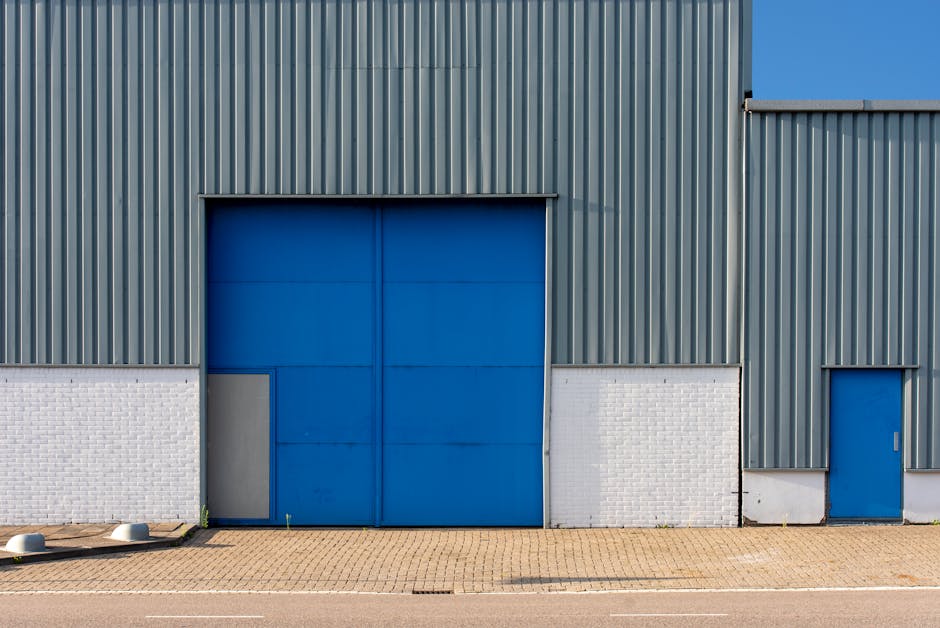
Commercial and industrial roller doors are different work to residential. The doors are larger, heavier, cycle 50-200+ times a day, and a failure shuts down the business. Here’s the buyer’s guide for Adelaide commercial premises.
What “commercial” actually means
Three broad categories:
Light commercial
Workshops, mechanic bays, retail back-of-house, small warehouses. Doors typically 3-4m wide × 3-4m tall. Cycle 20-100/day.
Heavy industrial
Loading docks, distribution centres, large workshops. Doors 4-6m+ wide × 4-5m tall. Cycle 50-200+/day. Often paired with high-speed motors.
Specialist commercial
Fire-rated rolling shutters, security shutters, food-grade clean-room doors, cold-storage doors. Each has compliance requirements that drive the spec.
Sizing and headroom considerations
Commercial doors carry the same headroom logic as residential — roller goes up into a coil; sectional goes back into the ceiling. But the spans are larger, so:
- Roller doors scale to about 6-7m wide before structural reinforcement gets significant.
- Sectional doors can go wider (industrial sectionals up to 12m+) but need ceiling clearance and back-room.
- High-speed doors (often fabric or aluminium) are the right call when cycle time matters more than insulation.
Your installer will measure the opening, the floor flatness, the side-jamb structure, and the headroom before specifying.
Motor spec
Commercial motor specifications scale to door weight, cycle rate, and required speed:
- Light-commercial chain or belt drive: 1-2 cycles/minute, suits up to 100/day cycles.
- Industrial direct-drive motors: 3-5 cycles/minute, suits 100-300/day cycles.
- High-speed industrial: 1-3 metres/second open speed; suits time-sensitive operations like cold-storage.
Motor sizing wrong = early burnout or door damage. Get the use-case right first; let the spec follow.
Fire-rated rolling shutters
Required for:
- Some retail tenancies (to satisfy fire-compartmentation requirements)
- Industrial premises with hazardous-materials adjacency
- Buildings being renovated where fire-engineering reports specify them
Certifications:
- AS/NZS 1905 testing (fire integrity / insulation rating)
- Manufacturer-specific certification (e.g. 1-hour, 2-hour, 4-hour ratings)
- Fire-engineering sign-off
Costs scale dramatically — a 4-hour fire-rated rolling shutter on a 4m × 4m opening can be $25,000-$45,000+.
Security roller shutters
Heavy-gauge aluminium or steel slats, often with reinforced bottom rails and security-grade locking. Common in:
- Retail shopfronts (after-hours protection)
- Self-storage facilities
- Industrial premises with theft exposure
Specifications:
- Slat thickness (1.0mm to 2.5mm typical)
- Wind-load rating (matters for cyclonic Australian regions; less so for Adelaide)
- Locking mechanism (manual, motorised with key override)
- Anti-jacking mechanism
Costs: $4,000-$15,000+ for typical retail shopfront sizes.
High-speed doors
Used where cycle time matters more than insulation — typically 1-3 metres/second open speed:
- Cold-storage entries (minimise refrigerated air loss)
- Food-processing zones (quick movement of pallets without environment contamination)
- Clean rooms (rapid open / close to maintain pressure)
- Drive-through service (vehicle wash bays)
Costs: $12,000-$45,000+ depending on size, speed, and material.
OH&S and safety equipment
Commercial doors need additional safety equipment beyond residential:
- Photo-electric sensors at multiple heights (not just floor level)
- Pressure-sensitive bottom edges (the door reverses if it touches anything during closing)
- Audible warnings during operation (beepers / strobes)
- Emergency stop buttons at key operator positions
- Manual emergency-release for power failure
- Light curtain systems on high-speed installations
Workplace-safety auditors check this stuff. Documenting it in the install package is standard.
Service plans
Commercial doors benefit from scheduled servicing more than residential. Recommended:
- Light-commercial: annual service ($480-$800).
- Heavy-industrial: quarterly service plan ($1,800-$4,800/year).
- High-speed / specialist: monthly inspections + quarterly servicing ($3,600-$9,600/year).
Service plans typically include priority emergency response, spare-parts holding, and OH&S certificate documentation.
Compliance and certification documentation
For commercial premises, your operator should hand over:
- AS/NZS testing certificates for the door (if applicable)
- Fire-rating certification (if applicable)
- Manufacturer warranty
- Workmanship warranty
- Service plan agreement (if signed)
- OH&S sign-off documentation
- Operational manual + emergency procedures
How to get a commercial quote
Commercial-job quoting is on-site only — too many variables for remote pricing. The steps:
- Submit through the free quote form — flag commercial in the message field.
- We route to a specialist commercial operator (not a residential-focus technician).
- On-site visit, requirement scoping, measurement.
- Written quote with itemised supply, install, certification, and service-plan options.
- Decision and project plan.
Lead times for commercial installs are typically 4-12 weeks depending on door spec, certification requirements, and supplier lead times.
Related
Need a hand with your garage door?
One short form. We connect you with one trusted Adelaide garage door technician for a written, fixed-price quote. Same-day for emergency repairs.